Casino Directory Boards and Printed Maps Serve Different Moments
Casino directory boards and printed maps serve different wayfinding needs: learn what each should show so guests can choose nearby stops and plan across the property.
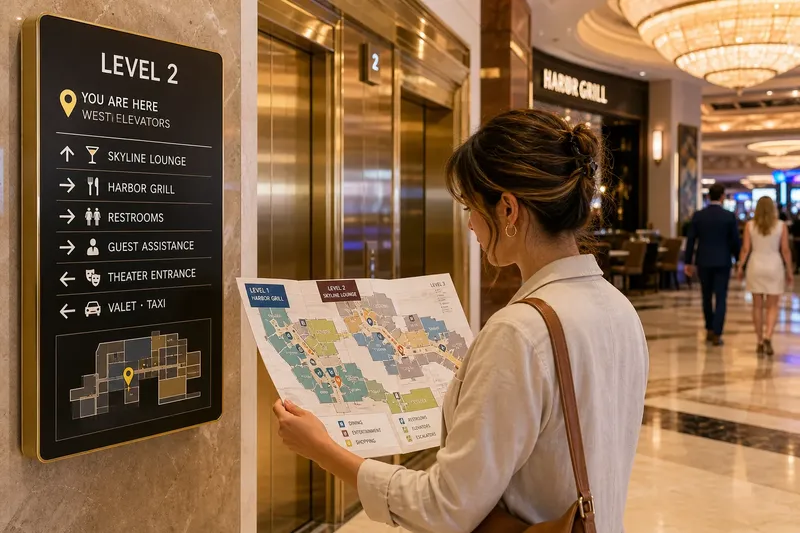
A casino directory board should answer, “What can I reach from here?” A printed casino map should answer, “How do these places connect across the property?” Giving each format a distinct job helps guests make local choices without crowding a board with the entire building.
Imagine an invented casino adds a restaurant near the east elevators and moves its show lounge to another floor. The design team can list nearby destinations and directions on the elevator directory, then show the restaurant, lounge, and connecting routes on the printed map. Guests can use the board to orient themselves and the map to plan beyond that spot.
A casino directory board supports decisions at one location
A directory is a fixed reference point, often placed at an elevator lobby or corridor junction. It helps a guest identify nearby destinations and choose a direction without carrying information away. A “You are here” marker connects the board to the surrounding space; a floor label clarifies which level the directions describe.
Use venue names guests can recognize, and group useful destinations such as dining, restrooms, guest assistance, and entertainment. Add landmarks—an elevator bank or theater entrance, for instance—when they make the directions easier to interpret. Keep promotional copy and decorative elements secondary. If they compete with names or directions, they are not worth the space.
A printed casino map shows the broader layout
A take-away map helps guests compare destinations in different parts of the property, plan several stops, and understand how public areas connect. It should make orientation clear and distinguish floors using the same labels guests see on directories and signs.
Choose symbols that remain legible at the map’s printed size, and keep important names and routes clear of folds. The map need not show every decorative feature. Detail is useful only when it helps a guest understand a destination, route, or connection.
Consistency matters more than identical content. A lounge should have the same name and floor label on the directory and the map, while each format can show different amounts of surrounding information. When a venue or route changes, update both formats together so guests do not encounter conflicting directions.
Keep local directions distinct from property-wide planning
Use the directory for destinations a guest can choose from the board’s location. Use the map for longer connections, destinations elsewhere in the building, and the relationship between multiple stops. Shared names, floor labels, and symbols help guests carry information from one format to the other.
Say an invented guest stands at the east elevators with a map, a destination list naming “Juniper Room” on level three, and a dinner reservation at “Harbor Grill” on level one. The guest checks the elevator directory for the current floor and the route toward the lounge, then uses the map to locate both venues and compare their positions. If the directory and map use the same names and floor labels, the guest can decide whether to visit the lounge before dinner; if those details conflict, the guest has a clear reason to ask staff which information is current.
Review a directory and map by checking what guests can understand
Start with the official venue names, floor labels, and current routes. Then compare the information on each format with the physical location it describes. Each check should lead to a practical decision rather than simply adding more detail.
- Check the directory’s floor label against the level where it is installed; if the label is missing or unclear, add the correct level, and if it is clear and accurate, leave it unchanged.
- Check whether the “You are here” marker aligns with a recognizable feature such as the elevator bank; if its position or orientation is ambiguous, revise the marker or board orientation, and if it is easy to relate to the space, retain it.
- Compare each venue name on the directory with the map; if the names differ, standardize them to the current official name, and if they match, keep the shared wording.
- Check a destination’s position relative to the directory; if the board can give a useful local direction, include it there, and if the destination is elsewhere in the property, show its broader location on the map instead.
- Inspect the printed map’s folds against its routes and labels; if a fold interrupts essential information, rearrange the panel layout, and if the information remains easy to read, keep the layout.
- Check whether promotional copy competes with names or directions; if it makes either harder to scan, remove it or move it away, and if it does not interfere, retain only copy that helps guests identify a destination.
- Note where staff receive recurring questions about a destination; if questions cluster near one directory, review that board’s wording and placement, and if they arise at another point, inspect the information guests encounter there.
For a worked review, imagine an invented casino where a directory at the west elevator lobby lists the “Skyline Lounge” on level two, while the printed map lists it on level three. The reviewer starts with two inputs: the current venue directory, which names level two as the lounge’s location, and the installed board and map. The reviewer checks the board’s floor label and marker against the west elevators, then compares the lounge name and floor on both formats. The observable result is a matching name but conflicting floor labels; using the current venue directory as the source for correction, the reviewer changes the map to level two and leaves the accurate board unchanged. If the current venue directory instead identified level three, the reviewer would correct the board rather than the map. The decision follows the verified source, not a guess based on which display looks newer.
Which format should answer a guest’s question?
What belongs on a casino directory board?
Show the current floor, a clear location marker, nearby destinations, and directions a guest can use from that point. Put broader property relationships on the map unless they help answer a local question.
When is a printed casino map more useful?
A map is useful when destinations lie in different areas or a guest wants to compare several stops. It also gives the guest a portable view of the property away from a fixed directory.
Should a directory and map show identical information?
No. They should share names, floor labels, and useful symbols, but the directory can focus on local choices while the map explains the broader layout. Duplicating every detail can make both formats harder to scan.
How can staff identify unclear wayfinding information?
Staff can note the destination questions guests ask and where they ask them. If the same question recurs near one display, review its wording, grouping, and placement before adding more information.
When reviewing casino directory boards and printed maps, ask whether each format answers the question a guest is likely to have at that location. A board should make nearby choices clear; a map should make the wider property understandable. Matching names and verified floor information let the two work together without turning either into a duplicate.